Line of Sight (EU2012): Difference between revisions
→Obstacles: more visual cover anomaly examples |
|||
| Line 5: | Line 5: | ||
Similar to the [[Cover (EU2012)|cover]] concept, most obstacles provide visual full/half/no cover and usually match with the defence counterpart. The entire cube/side acts as a blocker for vision, excluding the edges/corners if they coincide on the line of sight. Model shape does not seem to matter. | Similar to the [[Cover (EU2012)|cover]] concept, most obstacles provide visual full/half/no cover and usually match with the defence counterpart. The entire cube/side acts as a blocker for vision, excluding the edges/corners if they coincide on the line of sight. Model shape does not seem to matter. | ||
Some non transparent obstacles seem to provide | Some non transparent obstacles don't seem to provide matching visual cover. Not sure if it's a bug or a feature. The outer edge of (wooden) ramps and the back of service trucks and some pickup trucks provide either half or no visual cover. Whether logical or not, there are other less obvious cover obstacles with differing defence/visual cover (edge wall of supply ships have low cover but act as full visual cover, one high cover crate near the edge of [[Demolition EWI (EU2012)|Demolition EWI]] has half/no visual cover, there may be a visual cover issue with one of the curbs in [[SmallCemetery (EU2012)|Small Cemetery]], to name some instances). | ||
Transparent cover can exist, but usually only discovered through explosions. | "Transparent" cover can exist, but usually only discovered through explosions. Unit exploded vehicles (not the pre-configured ones in EW maps) that still provide cover may end up useless as vision blockers. An exploded wall with hanging objects intact (paintings/pictures, ladders) may still provide full cover while being visually transparent. | ||
Lastly, there are some exceptions that seem intended, such has the diagonal walls of UFOs, lampposts, flag poles, etc, which provide no defence cover and | Lastly, there are some exceptions that seem intended, such has the diagonal walls of UFOs, lampposts, flag poles, etc, which provide no defence cover alone and could have specific visual cover geometry. | ||
=== Estimating with the camera === | === Estimating with the camera === | ||
Revision as of 15:27, 7 May 2025
While the aesthetics of the in-game fog/vision appears vague, the only requirement for having line of sight of a voxel seems to be whether a unit can see the center point of that voxel. Units are two voxels high with the center point of the top voxel being where their origin of line of sight comes from. The requirement for line of sight of a unit seems to be whether there is line of sight of the top voxel of that unit, bottom is ignored. The game's cover mechanic extends a unit's origin/destination of line of sight.
Obstacles
Similar to the cover concept, most obstacles provide visual full/half/no cover and usually match with the defence counterpart. The entire cube/side acts as a blocker for vision, excluding the edges/corners if they coincide on the line of sight. Model shape does not seem to matter.
Some non transparent obstacles don't seem to provide matching visual cover. Not sure if it's a bug or a feature. The outer edge of (wooden) ramps and the back of service trucks and some pickup trucks provide either half or no visual cover. Whether logical or not, there are other less obvious cover obstacles with differing defence/visual cover (edge wall of supply ships have low cover but act as full visual cover, one high cover crate near the edge of Demolition EWI has half/no visual cover, there may be a visual cover issue with one of the curbs in Small Cemetery, to name some instances).
"Transparent" cover can exist, but usually only discovered through explosions. Unit exploded vehicles (not the pre-configured ones in EW maps) that still provide cover may end up useless as vision blockers. An exploded wall with hanging objects intact (paintings/pictures, ladders) may still provide full cover while being visually transparent.
Lastly, there are some exceptions that seem intended, such has the diagonal walls of UFOs, lampposts, flag poles, etc, which provide no defence cover alone and could have specific visual cover geometry.
Estimating with the camera
Use of the in-game camera in certain cases can make quick estimates of whether two points/areas will have line of sight of each other. Try to get vertical on the camera the line from the tile to an obstacle corner. Unfortunately, it's not exactly easy or possible if it requires the third dimension, or if the distances are too far away to create a vertical line.
- Off cover vision trick
-
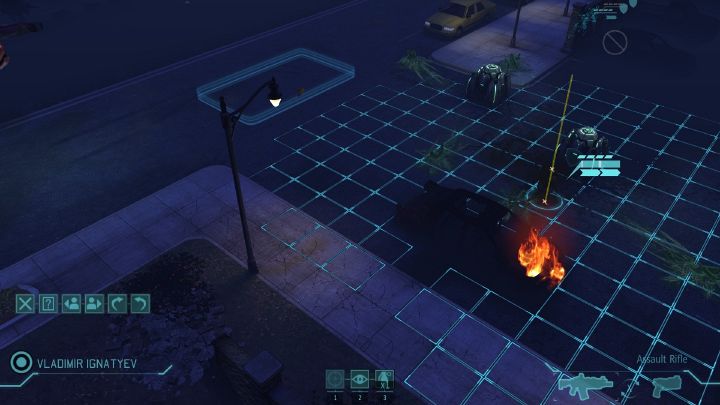 Any enemies using the car will not have sight of the soldier behind the alien object
 -
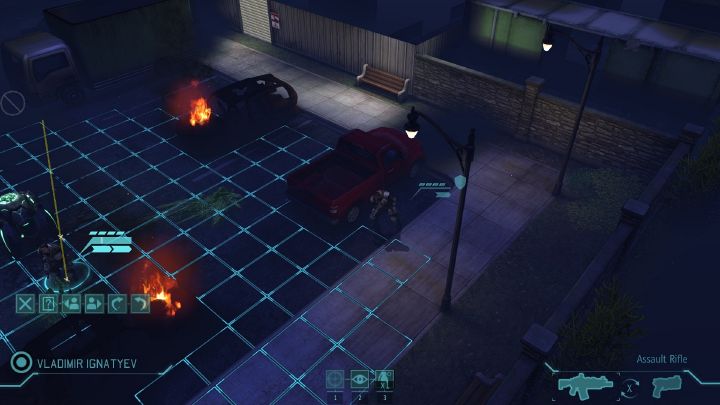 Similarly, the left corner of the truck is not visible


Peeking cover

Peeking tiles do not expand the vision range, only make parts of the vision sphere visible as additional source of line of sight. The origin/destination of line of sight are extended by peeking tiles, but limited to the original vision sphere centered on the unit. This is why when the unit steps out due to an action, they can sometimes trigger another pod, since the vision center/sphere actually shifts then.
While peeking, the entire segment from the unit's center point to the peeking tile center point is included, whether as attacker or target, not just the center point of the peeking tile.
Non visible attackers
This can explain weird circumstances like being targeted by non visible units. Let's say without any obstacles, both the attacker and the target are in vision range of each other at a diagonal in such a way that if there is full cover in front of the attacker, their outer/furthest peeking tile is outside the target's vision sphere. If the inner/closer peeking tile is also blocked by visual cover, then the attacker would appear to be non visible to the target.
The same idea applies when the attacker and target are just outside of each other's vision range, but the target is using cover and therefore their peeking tile is within the attacker's vision sphere. This was the case for the Sectoid in the cover visibility example.
See Also
 XCOM: Enemy Unknown: Gameplay Mechanics XCOM: Enemy Unknown: Gameplay Mechanics
|
| Action System • Movement • Chance to Hit • Cover • Critical Hits • Critical Wounds • Damage • Flanking • Line of Sight • Overwatch • Suppression |